
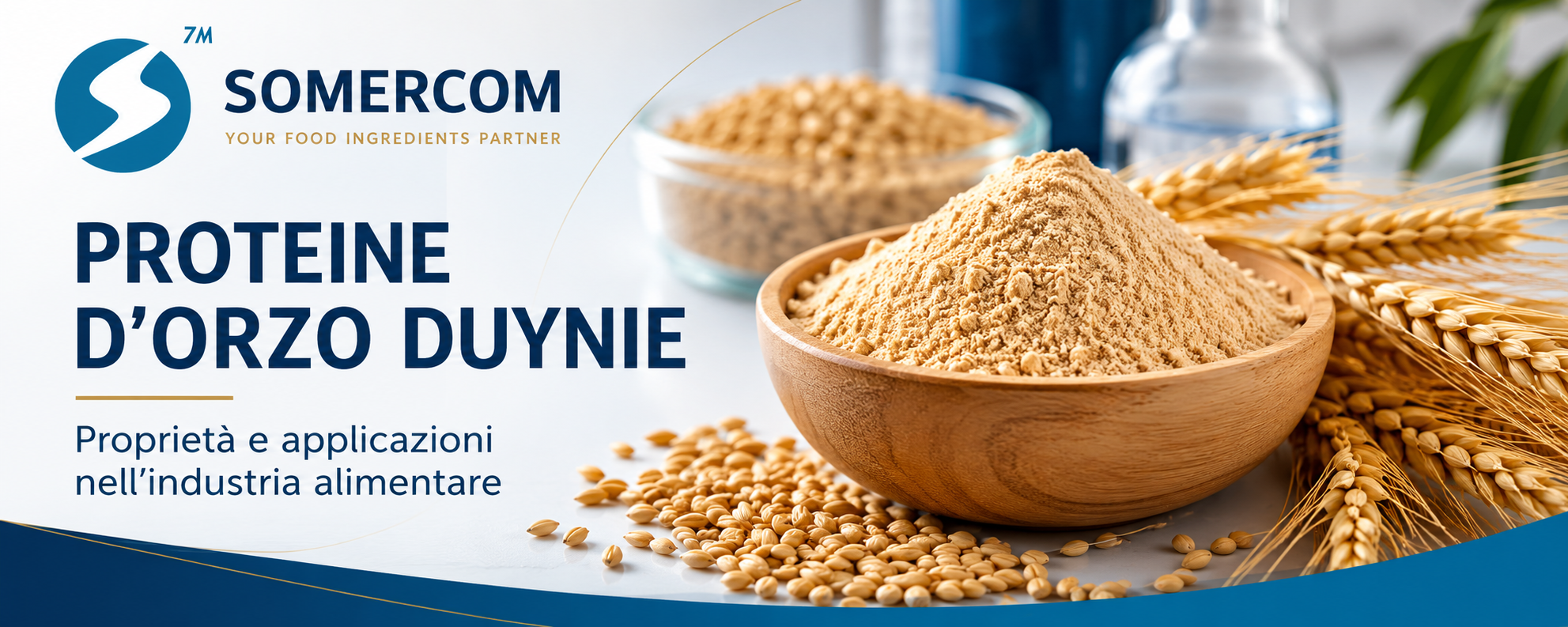
Barley Proteins: An Ingredient Created Through Resource Valorization
The food industry is undergoing a profound transformation, where innovation, sustainability, and quality are becoming increasingly interconnected. Today, the development of new food products depends not only on nutritional value but also on the origin of ingredients, the efficiency of production processes, and the ability to reduce waste throughout the supply chain.
In this context, Duynie barley proteins represent an innovative solution. Produced through the valorization of by-products generated during the brewing process, they make it possible to recover a naturally protein-rich raw material and transform it into a valuable ingredient for a wide range of food applications.
This approach demonstrates how existing resources can be given a new purpose, supporting a more efficient production model based on the principles of the circular economy.
From the Brewing Industry to Food Ingredient
During beer production, barley is processed to extract the fermentable sugars required for brewing. Once this stage is complete, a fraction naturally rich in proteins remains.
Through dedicated recovery and processing technologies, this valuable material can be transformed into an ingredient for the food industry.
Duynie barley proteins are the result of this resource valorization approach. What was once considered a by-product becomes a valuable ingredient, contributing to a more efficient use of natural resources while reducing waste throughout the agri-food chain.
This process responds to the growing demand for sustainable ingredients without compromising quality or functionality.
The Functional Properties of Barley Proteins
Barley proteins are appreciated not only for their high protein content but also for their technological properties. As a plant-based ingredient, they are well suited to current market trends and can be incorporated into a wide variety of food formulations.
Their versatility allows food manufacturers to develop innovative recipes while maintaining consistent raw material quality and reliable processing characteristics. As with any functional ingredient, performance may vary depending on the formulation and manufacturing process.
For this reason, ingredient selection should always be based on the specific characteristics and technological requirements of the final product.
Applications in the Food Industry
Thanks to their functional characteristics, barley proteins can be used in numerous food applications. They are suitable for bakery products, high-protein foods, plant-based formulations, and many innovative recipes requiring functional ingredients with consistent quality.
Growing consumer interest in sustainable and protein-rich foods is making barley proteins an increasingly attractive option for companies seeking to develop innovative products capable of meeting evolving market expectations.
Sustainability and the Circular Economy
One of the most significant advantages of barley proteins lies in the way they are produced. By recovering valuable components from brewing by-products, resources that might otherwise be underutilized are transformed into ingredients with added value.
This approach fully reflects the principles of the circular economy, encouraging resource efficiency, waste reduction, and a lower environmental impact across industrial processes.
The Food and Agriculture Organization also recognizes the valorization of agri-food by-products as an important strategy for building more sustainable and resilient food systems.
A Market Driven by Innovation
Demand for ingredients produced through sustainable manufacturing processes continues to grow. Food companies are increasingly expected to develop products that combine quality, nutritional value, and environmental responsibility while maintaining production efficiency.
Barley proteins fit naturally within this evolving market, offering new opportunities for product innovation and supporting the development of increasingly advanced food formulations.
Choosing the Right Ingredient
Every ingredient contributes to the characteristics of the final product and can significantly influence the success of a formulation. Selecting the most suitable raw material is therefore a crucial step in product development.
As a supplier of ingredients for the food industry, Somercom supports its customers in selecting the most appropriate solutions for each application, providing technical expertise, industry experience, and continuous research into innovative, high-quality raw materials.
Duynie barley proteins are a clear example of how quality, innovation, and sustainability can work together to create value throughout the food supply chain.