
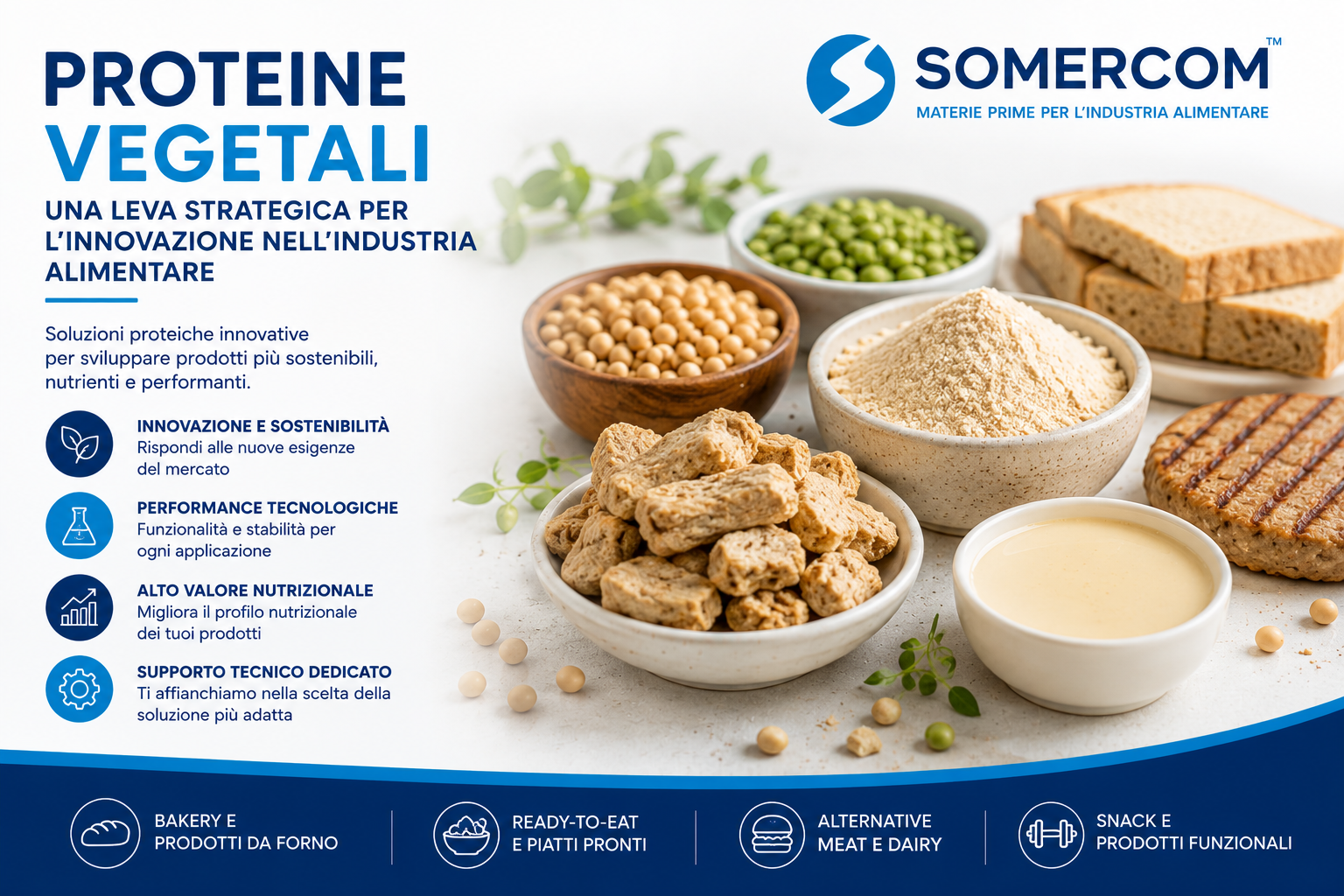
How Plant-Based Proteins Are Transforming Formulation, Production Processes, and Product Development
Vegetable Proteins: The New Frontier of Innovation in the Food Industry
In recent years, plant-based proteins have taken on an increasingly central role in the development of new food products. This is no longer just a trend linked to the plant-based sector, but a real transformation affecting research, formulation, and production processes across multiple areas of the food industry.
Today, companies are required to respond to new market demands, including greater attention to sustainability, the growing need for alternatives to animal proteins, and increasing interest in products with high nutritional value. In this context, plant-based proteins represent a strategic solution capable of combining innovation, functionality, and competitiveness.
An increasingly strategic ingredient for the food industry
Plant-based proteins are now used in a growing number of food categories. From bakery and ready-to-eat products to meat and dairy alternatives, their use is reshaping the way new formulations are developed.
The snack and functional food sectors are also experiencing strong growth in the use of plant-derived protein ingredients, thanks to their ability to improve nutritional profiles and differentiate the final product.
This evolution is not only driven by consumer demand but also by companies looking to develop innovative and more competitive product lines.
Not all plant-based proteins deliver the same performance
When discussing plant-based proteins, it is important to understand that there are many different sources, each with specific technical characteristics.
Depending on the raw material used, technological functionality, processing behavior, solubility, and sensory impact can vary significantly.
Taste, texture, and product stability may also change considerably, directly influencing industrial applications and production performance.
For this reason, selecting the right plant-based protein is a strategic step in the development of new food products.
The impact of plant-based proteins on process and formulation
Introducing plant-based proteins into a recipe can significantly influence product behavior during processing.
Final texture, water retention capacity, stability, and cooking performance are all aspects that can be directly affected by the type of protein selected.
Achieving consistent and high-performing results often requires technical optimization that takes into account both the characteristics of the ingredient and the company’s production goals.
A rapidly evolving market
The plant-based protein market continues to grow rapidly, supported by the development of new protein sources and increasingly advanced extraction technologies.
This scenario creates important opportunities for companies aiming to innovate, reformulate existing products, or introduce new high-value solutions.
Plant-based proteins are no longer simply an alternative, but a strategic component for the future of the food industry.
Technical support in choosing the right plant-based proteins
Selecting the most suitable raw material requires technical expertise and an in-depth understanding of industrial applications.
As suppliers of raw materials for the food industry, Somercom support companies in identifying the most effective solutions based on final application, required performance, and product objectives.
Contact us
Would you like to explore the potential of plant-based proteins for your production processes?
📩 Contact us to receive technical support and identify the solution best suited to your production needs.