
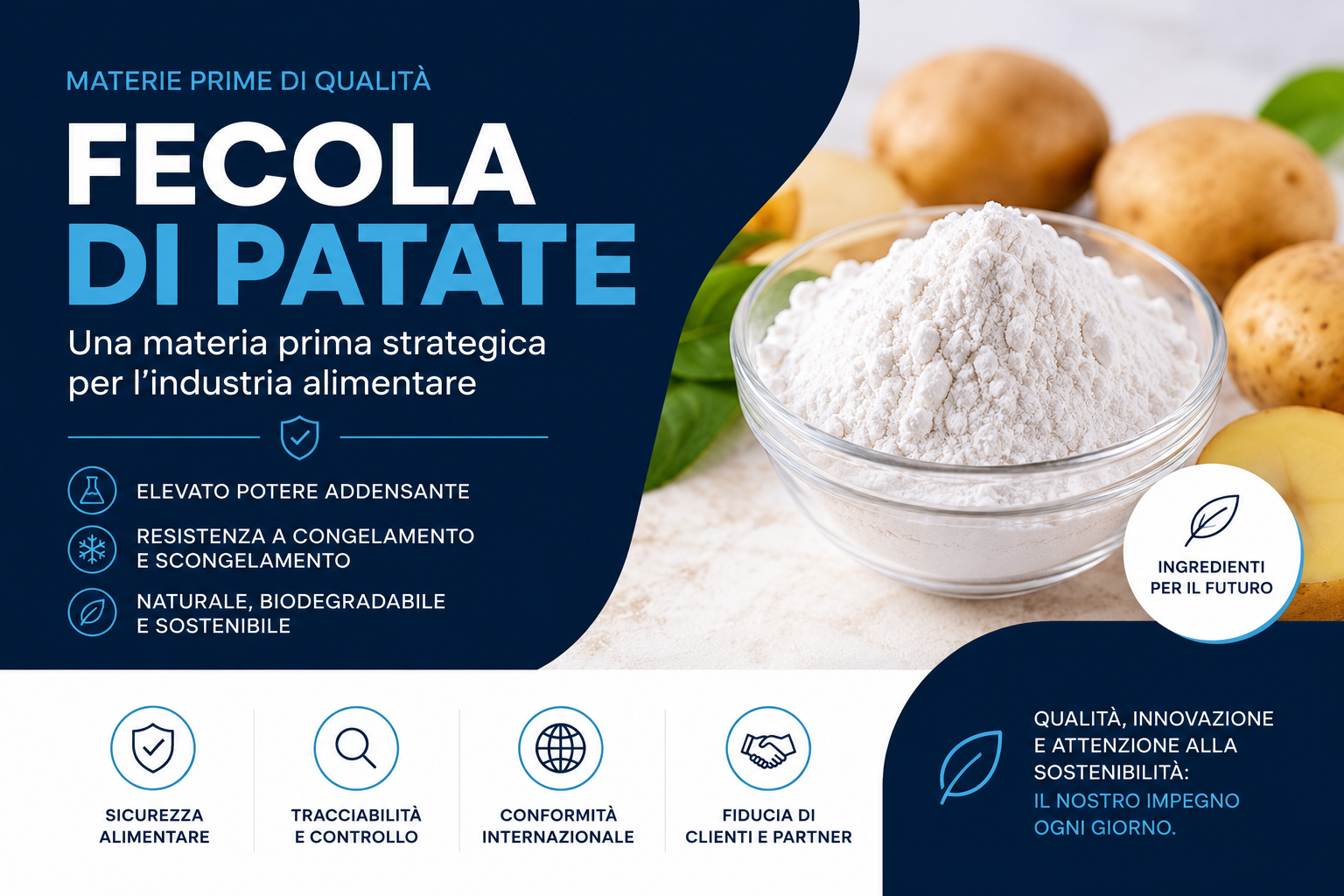
Potato Starch: Properties, Applications and Sustainability in the Food Industry
The Functional Properties of Potato Starch
Potato starch is widely appreciated for its technological characteristics, making it suitable for a wide range of industrial applications.
From a functional perspective, it offers:
high thickening power
stable viscosity
resistance to freeze-thaw cycles
neutral taste and color
These properties help manufacturers achieve products with uniform texture, long-term stability, and consistent quality.
For more information about functional ingredients in food processing, visit European Food Safety Authority (EFSA).
Applications of Potato Starch in the Food Industry
Thanks to its versatility, potato starch is used in many food production sectors, including:
sauces and dressings
creams and desserts
bakery products
ready meals and frozen foods
Its ability to maintain stability and structure makes it particularly suitable for the evolving needs of modern food manufacturing.
Learn more about our food industry raw materials and food processing solutions.
Sustainability and Environmental Impact of the Supply Chain
oday, understanding the environmental impact of food ingredients has become essential. For this reason, the potato starch supply chain is increasingly investing in innovation and sustainability.
Many production facilities now adopt solutions such as:
recovery and reuse of process water
optimization of energy consumption
improved plant efficiency
These innovations significantly reduce the environmental impact of industrial production.
Sustainability strategies in the agri-food sector are also promoted by the Food and Agriculture Organization.
Circular Economy and By-Product Valorization
One of the most interesting aspects of the potato starch supply chain is its ability to utilize almost every component of the raw material.
By-products can be reused in several ways:
fibers are used as animal feed
proteins can be reused in food or technical applications
organic residues can be converted into energy through biogas production
This approach reduces waste and supports concrete circular economy models.
Life Cycle Assessment (LCA): A Strategic Approach
Potato starch is also a relevant example in terms of Life Cycle Assessment (LCA), a methodology used to evaluate the environmental impact of a product throughout its entire life cycle.
As a natural and biodegradable substance, it is particularly attractive for applications requiring compostable or easily degradable materials.
An Ingredient Combining Innovation and Performance
For companies operating in the food industry, choosing potato starch means selecting an ingredient capable of combining:
high technological performance
application versatility
sustainability awareness
production reliability
Integrating LCA criteria into corporate strategies enables more informed and future-oriented decisions.